Geosynthetic clay liner
A roll-out waterproofing liner based on bentonite clay.
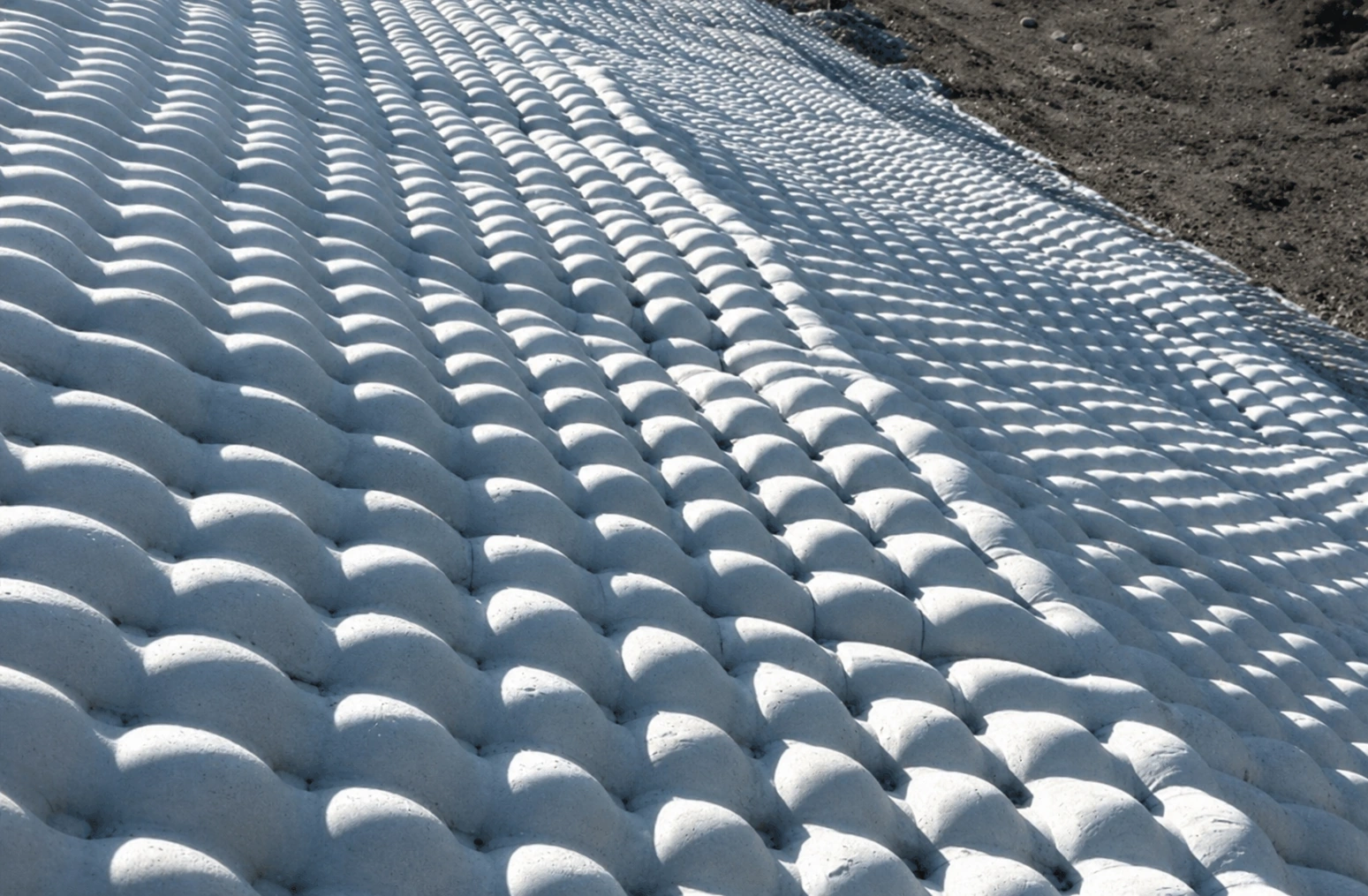
A textile form shapes the surface as it is filled with concrete. The design determines the thickness, substrate preparation and edge restraints based on the slope and flow conditions. ТОО «KazPolimer Engineering» · kazpolimer.kz
Read the detailed description Applications
 Benefits
 Installation
| Property | BNM 1 0.16 | BNM 1 0.2 |
|---|---|---|
| Thickness, mm | 160 | 200 |
| Grout volume, m³/m² | 0.083 | 0.125 |
| Filled mattress mass, kg/m² | 167 | 250 |
| Lining formation | Fabric form filled on site | Fabric form filled on site |
Values are for the listed variants in the KazPolimer catalogue. Specify the grout mix, panel layout, joints and edge restraints in accordance with the design and the manufacturer's instructions.
A fabric form is laid to the design profile and filled on site with a flowable cementitious mix. Two layers of fabric form the enclosure, while internal ties control the spacing between them during filling. As the mix hardens, it forms a weighted facing over the prepared ground. The mattress follows the intended surface profile and shields the ground from the direct action of flowing water. Empty sections can be transported to the work area and formed in place, which is useful when handling space is limited along a bank or slope.
The architecture of the form determines the surface profile and filled thickness. A specification addresses the form, pumpable fill, panel connections, bearing surface and drainage as parts of the same design. Identify where the works are intended to control erosion and where they must also restrict seepage. For seepage control, the designer assesses the permeability of the complete construction, including panel transitions, junctions with structures and the route by which water could enter from beyond the lined area.
In channels, concrete-filled mattresses can protect the bed and side slopes where flow would otherwise erode exposed soil. On banks, the facing is exposed to changes in water level and to flow along the shoreline. At culverts and bridge structures, designers assess how changes in direction and velocity affect the protection, especially where a concentrated discharge returns to unlined ground. For embankments and cut slopes, distinguish diffuse runoff from flow that collects in channels near the toe.
On refurbishment projects, survey data from after a flood can be particularly useful. Include the profile of remaining protection and photographs of places where the underlying material has already been exposed. Sites beside water also need suitable access for placing the fabric forms and delivering fill. The construction plan should address safe access and the conditions needed for the filled mattress to develop its specified strength.
Selection depends on the design slope, the condition and properties of the soil, expected water levels and the nature of the flow. On a steep slope, assess overall stability and how the fabric may move while being filled. Water level changes may produce pore pressure behind the facing. Where the construction includes a filter layer, its specification should take account of the underlying soil and the required water passage. Some fabric-form systems incorporate filter points. Confirm their availability and suitability for the proposed product and the project.
Erosion can develop where the facing meets exposed soil, around an outlet or near the toe. The lower termination, crest restraint and side returns should therefore follow the protection limits and the channel or slope levels. Details may include a recessed edge, a transition to a drainage channel or a connection to a rigid surface.
Plan work areas around the panel geometry and the sequence for supplying grout or concrete. Check the prepared ground, levels and any required filter before laying out the forms. Position the empty sections with the filling sequence in mind and connect them as specified. Review fabric condition, restraints and access to filling points before pumping. Confirm the mix and pumping requirements with the supplier for the selected form. A trial section can show how filling affects the finished profile and alignment with adjacent sections.
During filling, check the shape of each section, the stability of its edges and the condition of the seams. Once the fill has hardened, review coverage, junctions, transitions onto soil and surface drainage from adjoining areas. Record the filter and buried restraints before they are covered. Following a significant flow event, inspect the toe and exposed edges. Local erosion next to the facing can reveal a developing problem outside the lined area.
Send KazPolimer the cross-sections, protection limits, dimensions measured along the slope, water levels and intended longitudinal and transverse seams. Add available information about the soil, the design filled thickness and any filter requirements. Identify connections to drainage structures, pipes, walls and existing protection. Photographs are useful for showing unloading restrictions and where the filling crew can approach the work area.
Distinguish the area to be covered from the panels, connectors, edge restraints and fill-related requirements. The plan area differs from the area on a slope, so a preliminary quantity should use the actual profile dimensions. For comparing quotations, ask for the dimensions of the supplied sections, the declared fill consumption and the preparation work assumed in the offer. Include the location in Kazakhstan and when the materials are needed on site.
It is a textile form laid on site and filled with a concrete mix. Once the concrete cures, it forms a lining with the specified profile.
They can protect channel beds, slopes, banks and embankments against erosion. Suitability depends on flow conditions and the underlying ground.
A fabric mattress receives mixed concrete on site. A concrete blanket already contains a dry cementitious mix that hardens after hydration.