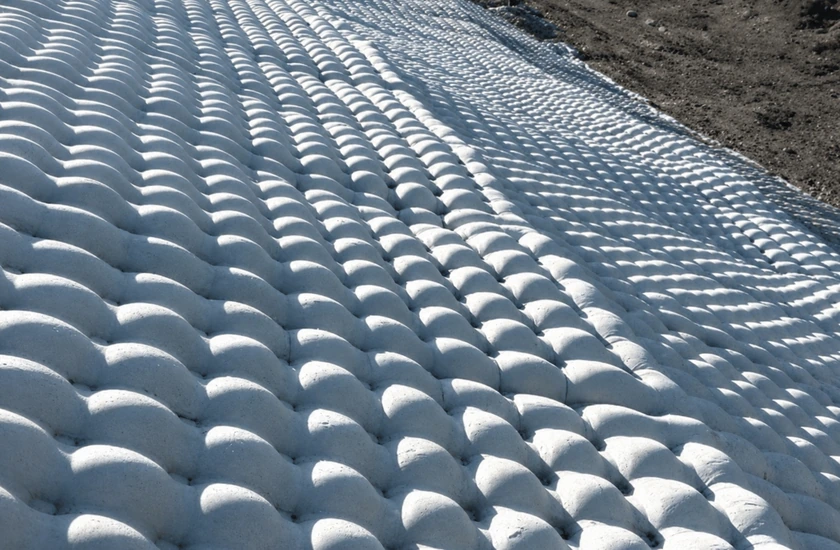
Anchored liner sheet
Polymer lining for protecting reinforced concrete exposed to aggressive media.
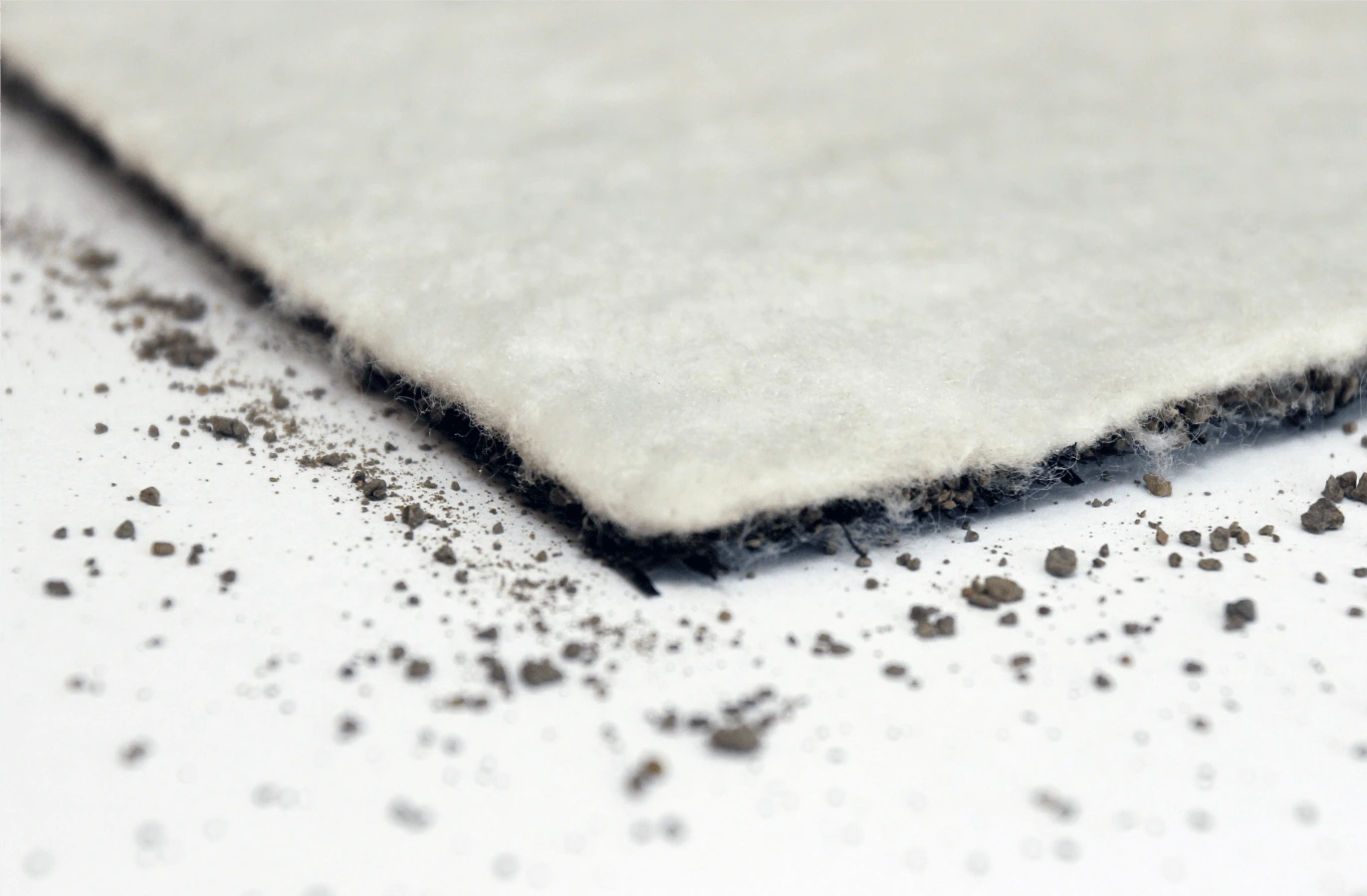
Bentonite swells on hydration to form a low-permeability layer. Specify the liner for the water chemistry, confinement conditions and details where the liner meets other parts of the structure. ТОО «KazPolimer Engineering» · kazpolimer.kz
Read the detailed description
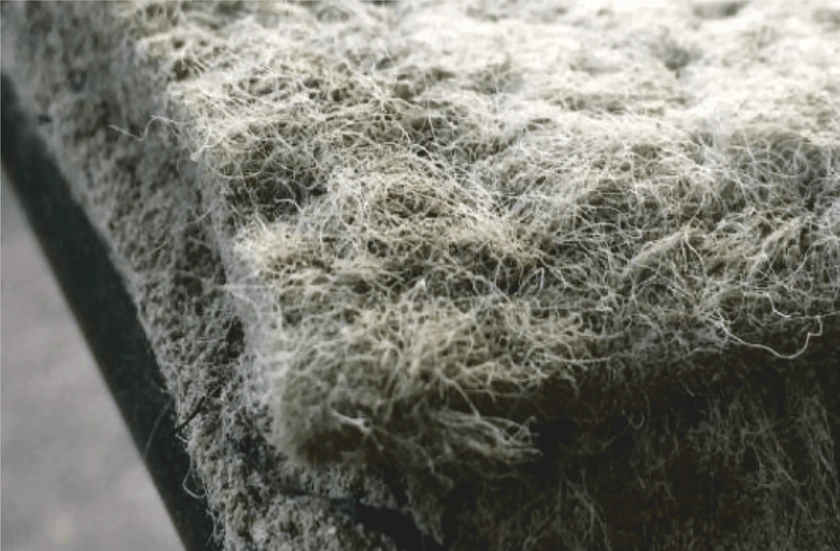
Bentonite between woven and nonwoven geotextile layers.
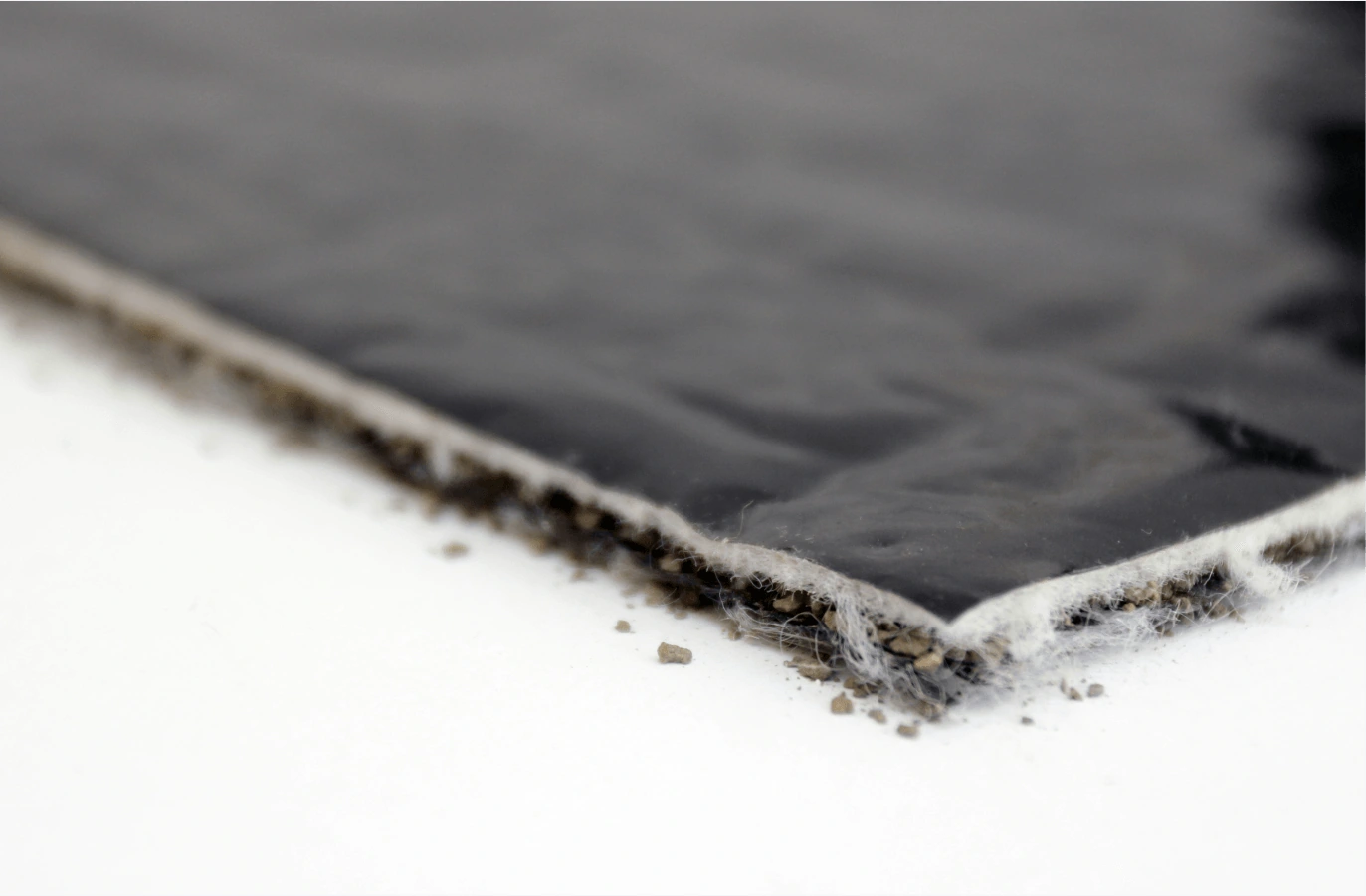
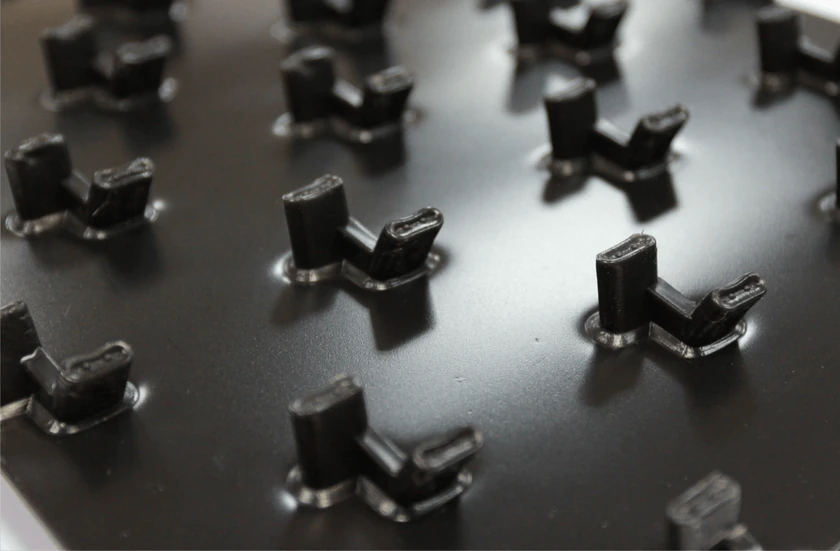
A version with an additional polymer layer.
 Applications
 Benefits
 Installation
| Property | AS 50 | AS 100 | ASL 50 [1.0] | ASL 100 [1.0] |
|---|---|---|---|---|
| Construction | Bentonite and geotextile | Bentonite and geotextile | Liner with polymer layer | Liner with polymer layer |
| Mass per unit area, kg/m², tolerance ±10% | 3.9 | 5.2 | 4.1 | 5.4 |
| Thickness at 2 kPa, mm | 5.4 | 5.76 | 5.58 | 5.94 |
| Minimum tensile strength, kN/m | 12 | 12 | 12 | 12 |
| Maximum hydraulic conductivity normal to the plane at 200 kPa, m/s | 3.0 × 10⁻¹¹ | 1.5 × 10⁻¹¹ | See datasheet | See datasheet |
| Minimum bentonite swell index | 24 ml per 2 g | 24 ml per 2 g | 24 ml per 2 g | 24 ml per 2 g |
Values apply to the grades shown in the KazPolimer catalogue. Confirm roll dimensions, the properties of the ASL polymer layer and confinement requirements for the project.
A bentonite mat is a geosynthetic clay liner supplied in rolls. In AS, the mineral layer is held between woven and nonwoven geotextiles. Bentonite swells as it takes up water. With confinement from the adjoining construction, the hydrated clay forms a barrier with low hydraulic conductivity. The liner is selected for its position in the whole cross-section, including the prepared base, confining cover, seams and transitions.
In a lined pond, confinement may come from the protective soil placed over the liner. Along a below-grade wall, the designer considers backfill, contact with the structure and the joint at the foundation slab. Rain can wet exposed rolls or panels before these layers are in place. Plan the extent of each work area around the ability to protect the bentonite and preserve its overlaps until the liner is covered.
AS contains bentonite between the two geotextile faces. ASL adds a geomembrane to the liner construction. Selection starts with the order of the adjoining layers and the location of each panel's membrane or textile face. Review the joint between rolls as well as the connection to a concrete upstand or a different barrier. A large flat area, a slope and a pipe crossing may each require a different detail for the same liner.
Where the design calls for welded seams in the geomembrane layer, check that the proposed ASL edge construction allows for the specified work. Define how the clay portion continues across the joint, who can access the polymer seam for inspection and how the panel meets the adjoining seal at the boundary. Review grade-specific drawings and test conditions when comparing quotations for AS and ASL.
Bentonite liners can form part of pond and reservoir seepage barriers and waterproofing systems for below-grade structures. Pond design inputs include water levels, the shape of the basin, slope geometry and the cover soil. Underground work requires a review of construction joints, pipe entries, tie-ins to the slab and the ability to backfill without disturbing the installed liner. A layout defines the area the barrier must follow, including transitions at the perimeter.
Dissolved salts and process chemicals can affect how bentonite swells and how readily liquid passes through it. When the site liquid differs from the liquid used for the product's test data, discuss compatibility evidence with the project team. Identify the likely source of initial hydration and the liquid expected in long-term service. The two may differ on a site where stormwater enters the basin before process operation starts.
Project drawings and the applicable installation instructions establish the subgrade preparation, panel orientation and attachment at critical details. A layout shows side laps, end laps, crest anchorage and connections to structures. Coordinate the placement of the cover with the direction and sequence of panel deployment. On a project with several work fronts, set out safe temporary edges and agree which covered areas can be accepted each day.
On slopes, the designer evaluates stability at the interfaces of the actual soil and liner system. Between material selection and cover placement, consider gradients, the moisture conditions and loads introduced by construction equipment. The cover provides confinement and helps protect the liner from stones and equipment. Specify the cover material and placement sequence so the overlaps remain in position and vehicles stay off the exposed mat.
At delivery, match the grade, batch markings and roll dimensions against the documents. Record torn protective wrapping, moisture or handling damage and follow the supplier's storage instructions. Before covering a panel, check orientation, verify the required overlaps and clear access for inspection at edges and penetrations. Record wetting or damage promptly so it can be assessed before the work becomes concealed.
Link the roll record to the installation plan. A record identifies the position of material batches, details at unusual corners and repairs agreed with the project team. Where the ASL configuration includes welded membrane joints, include the seam checks in the inspection record. It is easier to confirm the boundary and penetrations while the full detail is visible than to reconstruct their position after backfilling.
For supply in Kazakhstan, share the basin layout or structure sections with KazPolimer, together with the water conditions, cover construction and materials in direct contact. Include the grade if it is specified and the test conditions for the permeability requirement. Calculate supply quantities from the layout, including laps, cut pieces and details around structures. State any lifting restrictions and phase the roll schedule to suit access and the planned order of work on site.
Bentonite swells when hydrated and forms a low-permeability layer. Barrier performance depends on water chemistry, confinement and joint detailing.
ASL includes an additional polymer layer. Check the product data sheet for the construction and properties of the chosen grade.
It can form part of waterproofing for below-grade structures or a seepage barrier for ponds and reservoirs. The design specifies the required protection and confinement layers.